
Fraud prevention is what a company does before, during, and after an attempt to deceive it. The work is broader than stopping a suspicious payment. It includes making fraud harder, noticing when a journey no longer looks normal, and containing the damage when a bad decision gets through.
Consider a promotion that gives every new account a $20 credit. A signup CAPTCHA may stop a basic script, but it won’t notice one person operating many devices, a farm of apparently valid accounts, or a support agent granting repeated exceptions. MFA solves a different problem. A transaction rule solves another. Each control sees only part of the event.
That is why a usable fraud prevention guide has to connect people, process, and technology. The sections below apply that approach to registration, login, checkout, promotions, recovery, and support rather than treating fraud as one generic threat.
What Fraud Prevention Means for an Online Business
Fraud involves deliberate deception for gain. On a website or app, it rarely stays inside a neat category. A phishing message can lead to stolen credentials, then to an account takeover, and finally to a fraudulent order or refund. Fake accounts may support promotion abuse one week and resale fraud the next. Automated traffic often supplies the scale.
Direct losses are only the visible part. Teams also absorb chargebacks, inventory shortages, analyst time, support contacts, bad campaign data, and added friction for customers who did nothing wrong. The FBI Internet Crime Complaint Center’s 2025 annual report offers a public view of reported cyber-enabled crime. It cannot tell a particular retailer, bank, or marketplace where its own exposure sits; only the company’s incident and journey data can do that.
In practice, the program has three jobs:
- Prevent: reduce opportunities through identity, access, workflow, and transaction controls.
- Detect: combine signals to find suspicious behavior before or after an action.
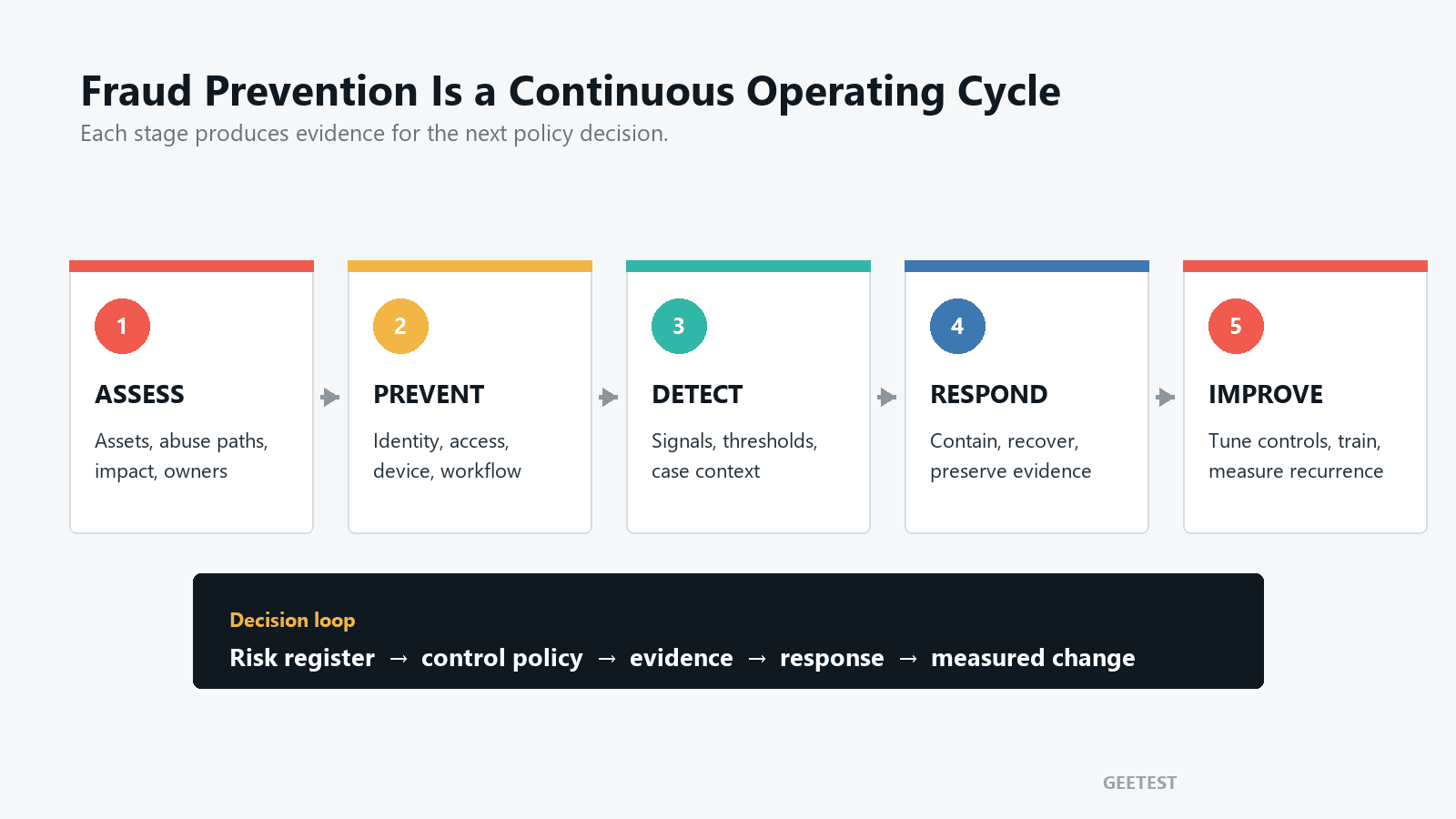
- Respond and improve: contain incidents, preserve evidence, recover safely, and feed lessons back into policy.
The third job is easy to neglect. Teams close a case, recover the account, and move on. Attackers then try the same route again. Someone must own the follow-up, whether that person sits in fraud, security, product, engineering, payments, or support. Legal and compliance teams may also need to be involved, depending on the event and jurisdiction.
Start With a Fraud Risk Assessment
Buy a tool too early and the assessment quietly becomes a list of things that tool can detect. Start with the business instead. The ACFE and COSO Fraud Risk Management Guide frames fraud risk management as continuing organizational work, not a checklist completed once for an audit.
List what an attacker would actually value: an established customer account, stored payment credentials, a welcome credit, digital inventory, personal data, a seller payout, or control of an account-recovery channel. Next, locate the moments where those assets can change hands. Signup and checkout are obvious. Password reset, refund approval, payout destination changes, coupon redemption, and support-assisted recovery are just as important.
Take one journey at a time and ask:
- What outcome is the attacker trying to achieve?
- Which identities, devices, credentials, or payment instruments are involved?
- What normal behavior should the business expect?
- Which controls exist before, during, and after the action?
- What is the likely financial, operational, and customer impact?
- Who owns the decision when the evidence is uncertain?
Put the answers in a risk register, but write the scenario so it can be tested. “Bots” is too broad. “Automated account creation used to redeem the first-order credit” gives the team a journey, an action, and an outcome to observe. Add the current controls, remaining exposure, owner, escalation route, and review date.
Likelihood alone is a poor priority score. A noisy low-value attack can consume hundreds of review hours, while a rare recovery attack may expose an entire account. Look at both frequency and consequence. The assessment won’t predict the next trick. Its value is more practical: it exposes the decision the company is making before an incident makes that decision for it.
Build Layered Preventive Controls
Layering controls makes an attacker beat more than one independent check. It also lets the company reserve stronger friction for the moments that justify it. Showing every visitor the hardest challenge is technically simple, but usually a poor operating policy.
| Control layer | Example controls | Primary purpose | Watch-out |
|---|---|---|---|
| Identity and access | MFA, password controls, recovery verification, privileged-access review | Reduce unauthorized access and account misuse | Recovery flows can become the weakest route |
| Human and automation | Rate limits, bot detection, step-up CAPTCHA | Slow scripted signups, login attempts, scraping, and abuse | Universal challenges can harm conversion and accessibility |
| Device and network | Device identity, IP and proxy context, velocity, session linkage | Find repeated or coordinated activity across accounts | A single device or IP signal is not proof of fraud |
| Behavior | Navigation, interaction, timing, sequence, unusual changes | Identify departures from expected user behavior | Models and thresholds require monitoring for drift |
| Transaction and business rules | Amount, frequency, recipient change, coupon limits, payout delay | Control financial and promotion exposure | Rigid rules can block good customers |
| People and process | Dual approval, employee training, vendor checks, separation of duties | Reduce insider, social-engineering, and operational risk | Controls fail when exceptions are undocumented |
The risk of the action should influence authentication strength. NIST’s Digital Identity Guidelines cover a wider subject than fraud, yet the principle transfers well. Reading a public page, signing in from a familiar device, changing a payout destination, and recovering an account should not inherit one identical verification rule.
For automated abuse, bot detection supplies traffic and interaction context before a response is chosen. GeeTest Adaptive CAPTCHA can add human verification when a session crosses a risk threshold. A known, low-risk session may continue quietly; an uncertain one may receive a step-up; an obviously abusive one may be limited without offering endless challenge retries.
Device context adds a separate view. GeeTest Device Fingerprinting generates device identity and risk signals that can help connect repeated activity. Suppose ten accounts appear unrelated at the identity layer but share device traits, timing, and the same promotion pattern. Together those facts merit attention. The device signal by itself still isn’t a fraud verdict.
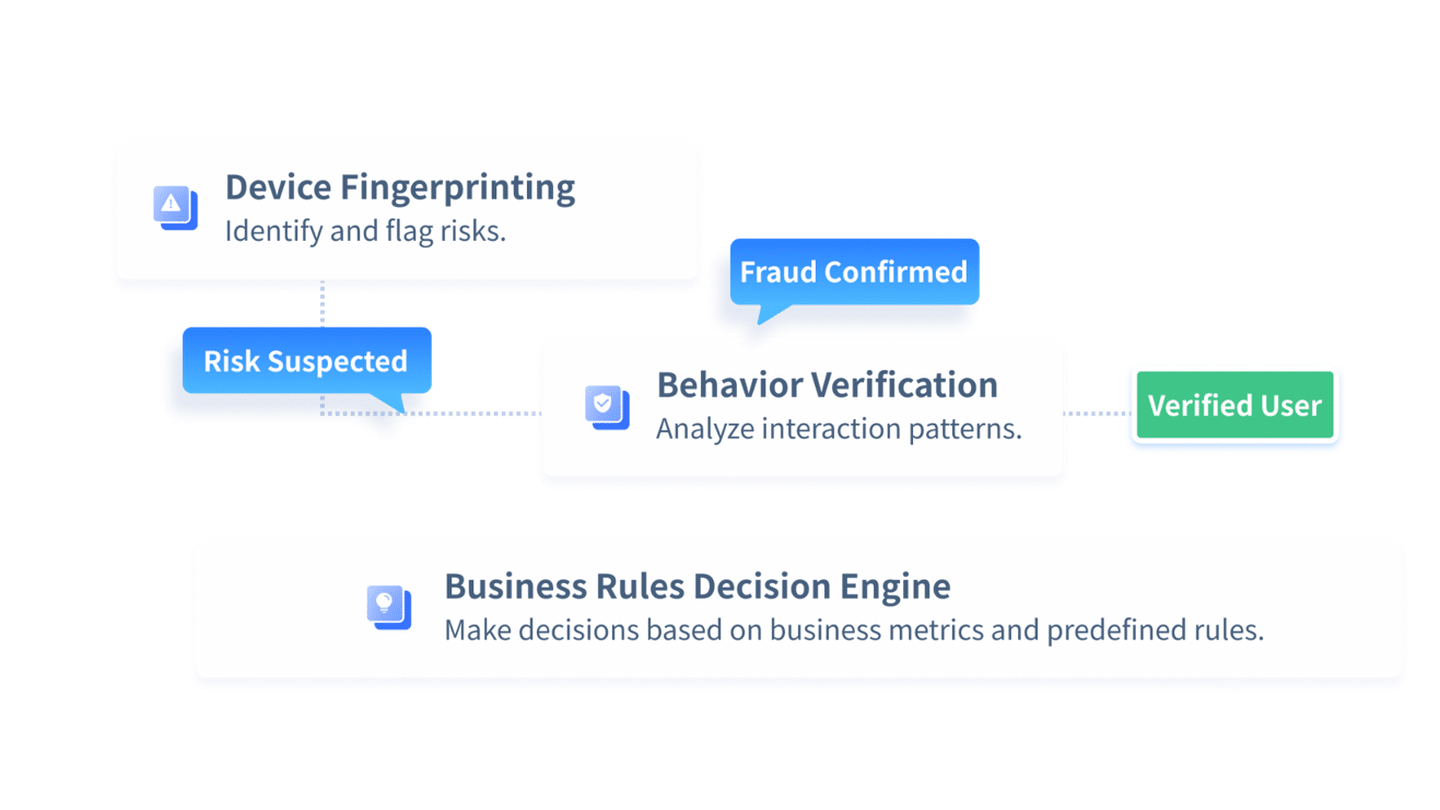
Rules join the layers. They can allow a familiar low-risk session, ask for verification after a sensitive change, delay a payout, or send an uncertain case to an analyst. New rules should begin where their effect can be observed. Document exceptions, sample the cases they would affect, and only then expand enforcement. Otherwise the first sign of a bad threshold may be a queue of legitimate customers asking for help.
Detect Fraud With Signals, Not One Red Flag
Detection is the work of turning ordinary events into enough context for a decision. Useful evidence tends to come from several places:
- Identity signals: account age, verification state, credential changes, failed login patterns.
- Device and network signals: device linkage, emulator or automation indicators, IP reputation, proxy use, velocity.
- Behavior signals: navigation sequence, interaction timing, repeated attempts, unusual session changes.
- Transaction signals: amount, frequency, payment mismatch, recipient change, refund pattern, promotion usage.
- Context signals: customer history, time, location consistency, campaign rules, known lists, current attack patterns.
Red flags are leads, not conclusions. People replace phones. Families share networks. A large order may be perfectly normal for a long-standing business customer. Detection becomes more reliable when independent facts agree and when the response reflects the cost of being wrong.
That response doesn’t have to be a binary allow or block. A low-risk event can be logged. An uncertain session might get a CAPTCHA, MFA prompt, confirmation, or temporary limit. A payout with several high-risk signals may be delayed for review. Whatever the outcome, support staff and analysts need enough decision context to handle an appeal without guessing.
Review false positives with the same attention given to caught fraud. A control can reduce chargebacks and still be a bad control if it rejects good customers or creates a costly support queue. Samples should include confirmed fraud, cleared cases, complaints, abandoned challenges, and repeat attempts that moved to a different account or device.
Adjacent channels can reveal what a single dashboard misses. Click fraud protection, for example, deals with invalid ad interactions. The onsite team sees what happens next: automated signup, fake-account creation, or promotion redemption. Joining those views may show that a “traffic quality” problem is actually the first step in a longer abuse path.
Respond, Learn, and Improve After an Incident
Some fraud will get through. The response plan exists so the company doesn’t invent its process while money, accounts, or data are still at risk.
Containment comes first. Lock the affected account, pause the payout, invalidate sessions, revoke credentials, limit the promotion, or place the transaction in review. Before changing systems, preserve the logs and decision context the investigation will need. Write down what was affected and when each action occurred.
Next, give legitimate users a safe route back. A victim shouldn’t be forced to recover through the same email address, phone number, or session that the attacker controls. Support needs a verified alternative and a clear escalation point. Privacy, legal, compliance, and communications teams may need to join, depending on the facts and applicable requirements.
Trace the entry path rather than stopping at the final purchase or withdrawal. Phishing, credential stuffing, session theft, and social engineering can all end at a similar transaction. The FTC’s phishing guidance is useful material for employee and customer education. Internally, the more important question is where the chain could have been interrupted.
Then make the repair visible. Change the relevant rule, recovery step, training, list, or monitor; add the pattern to the risk register; and test for side effects. Give the change an owner and a date for review. Without that small piece of governance, a good post-incident recommendation often disappears as soon as the urgent case is closed.
Measure and Govern the Program
A fraud team can report a rising block count while the business is actually getting worse at fraud prevention. More blocks may reflect a bigger attack, a new threshold, internal testing, or extra false positives. Measures need context and should connect fraud outcomes with customer and operating costs.
A compact scorecard might include:
- fraud loss rate and prevented-loss estimates with documented methodology;
- attack or abuse rate by journey, channel, and pattern;
- challenge rate, completion rate, and abandonment after verification;
- false-positive rate and successful customer appeals;
- time to detect, contain, review, and recover;
- repeat incidents after a rule or control change;
- manual review volume, support contacts, and operating cost.
Split the numbers by journey. A sitewide challenge rate can hide an over-protected signup flow and a weak recovery flow. Compare changes with a baseline, and annotate launches, promotions, traffic-source changes, and policy releases. Otherwise a perfectly explainable shift can look like a fraud-control success or failure.
Finally, decide who may change a threshold, who reviews exceptions, and who approves enforcement. High-risk journeys and major controls need named owners. Keep a short decision log for material changes. Review the control after an incident, a new product journey, a meaningful shift in attack behavior, or on a fixed schedule.
The aim isn’t the largest block number. It is a result the business can defend: less fraud exposure, tolerable friction, a workable recovery path, and evidence for the next adjustment. Mapping critical journeys against the layers in this guide will show where human verification, device intelligence, and policy orchestration add value, and where a process or ownership gap matters more than another tool.
Fraud Prevention FAQ
1. What is fraud prevention?
Fraud prevention combines policies, day-to-day procedures, and technical controls to make deception harder, spot it sooner, and limit the damage. Online businesses need to cover identity, access, devices, behavior, transactions, employees, and response.
2. What are the three main types of online fraud?
There is no universal three-part taxonomy. A useful working split is identity and account fraud, payment and transaction fraud, and automated or platform abuse. Expect overlap: one incident can move through all three.
3. What are six core principles of fraud prevention?
Six useful principles are to assess the actual risk, name an owner, layer independent controls, combine signals, choose a proportionate response, and use results to improve the policy.
4. How should a business start a fraud prevention program?
Choose one valuable journey, such as account recovery or payout. Map the likely abuse, current controls, available evidence, impact, owner, and response. Capture a baseline, fix the largest gaps, and only then repeat the exercise elsewhere.
5. Can CAPTCHA prevent fraud by itself?
No. CAPTCHA can interrupt some automated activity and works well as a step-up check in the right place. It cannot replace identity checks, transaction controls, device and behavior evidence, employee procedures, monitoring, or incident response.