
The hard part of bot detection is rarely the first signal. Most security, fraud, and product teams can already see suspicious traffic somewhere in their logs. The harder decision is what to do when a request is risky but may still belong to a real customer, partner, search crawler, or approved automation.
An effective bot detection solution turns that uncertainty into an operating model. It connects evidence from traffic, devices, behavior, accounts, and endpoints with response rules that can verify, slow, monitor, or block activity without applying the same friction to every user.
This article focuses on that implementation layer. It starts with the abuse patterns a solution must cover, then maps the signal-decision-response architecture, explains why traditional controls are incomplete on their own, and shows how to design a flexible response layer for web, mobile, and API flows.
Why Bot Detection Needs a Solution, Not Just a Definition
Bot detection starts with identifying automated traffic and separating useful automation from suspicious or malicious activity. If you need the concept baseline first, start with what bot detection means. For a security or fraud team building a solution, the hard part is what happens next: a login retry, a checkout request, and a scraping session should not all trigger the same control.
Before choosing tools, teams need a working policy that answers five practical questions:
- Which signals make this session, device, request, or account risky enough to review?
- Which flow is under pressure: login, registration, checkout, API, campaign, content, or user-generated content?
- Which action is proportionate: allow, monitor, challenge, throttle, block, or review?
- How will the team notice false positives, false negatives, and conversion friction?
- Who can change the policy when attacker behavior shifts?
OWASP’s Automated Threats to Web Applications project is a useful reminder that automated abuse is not one attack type. Credential stuffing, scraping, carding, inventory denial, CAPTCHA defeat, vulnerability scanning, spam, and account abuse create different losses and need different response paths.
Threats an Effective Bot Detection Solution Must Cover
Many teams first notice bots as a traffic spike, but the operational damage usually appears elsewhere: failed logins, polluted analytics, support complaints, checkout pressure, fraud review load, or real users who cannot complete the flow.
The threat mix usually looks different by flow:
- Login flows often see credential stuffing and account takeover attempts, where attackers test leaked passwords at scale. Related reading: account takeover prevention.
- Registration and community flows attract fake accounts used for spam, promotion abuse, fraud, or platform manipulation.
- Content and product flows are common scraping targets, especially when price, inventory, product data, or gated content has business value.
- Checkout and limited-supply flows face inventory hoarding, scalping, and promotion abuse before real users can act.
- API layers need their own checks because automated clients may bypass browser-side controls.
- Challenge flows can be attacked through CAPTCHA-solving services, hybrid automation, or human labor.
- Analytics and growth funnels can be polluted by invalid conversions, making acquisition and fraud signals less reliable.
A suspicious login attempt, a content scraper, and a scalping script may share some signals, but a single response policy will usually overblock one group or underreact to another. Good detection keeps the response tied to the business flow being attacked.
Core Architecture: Signals, Decisions, and Responses
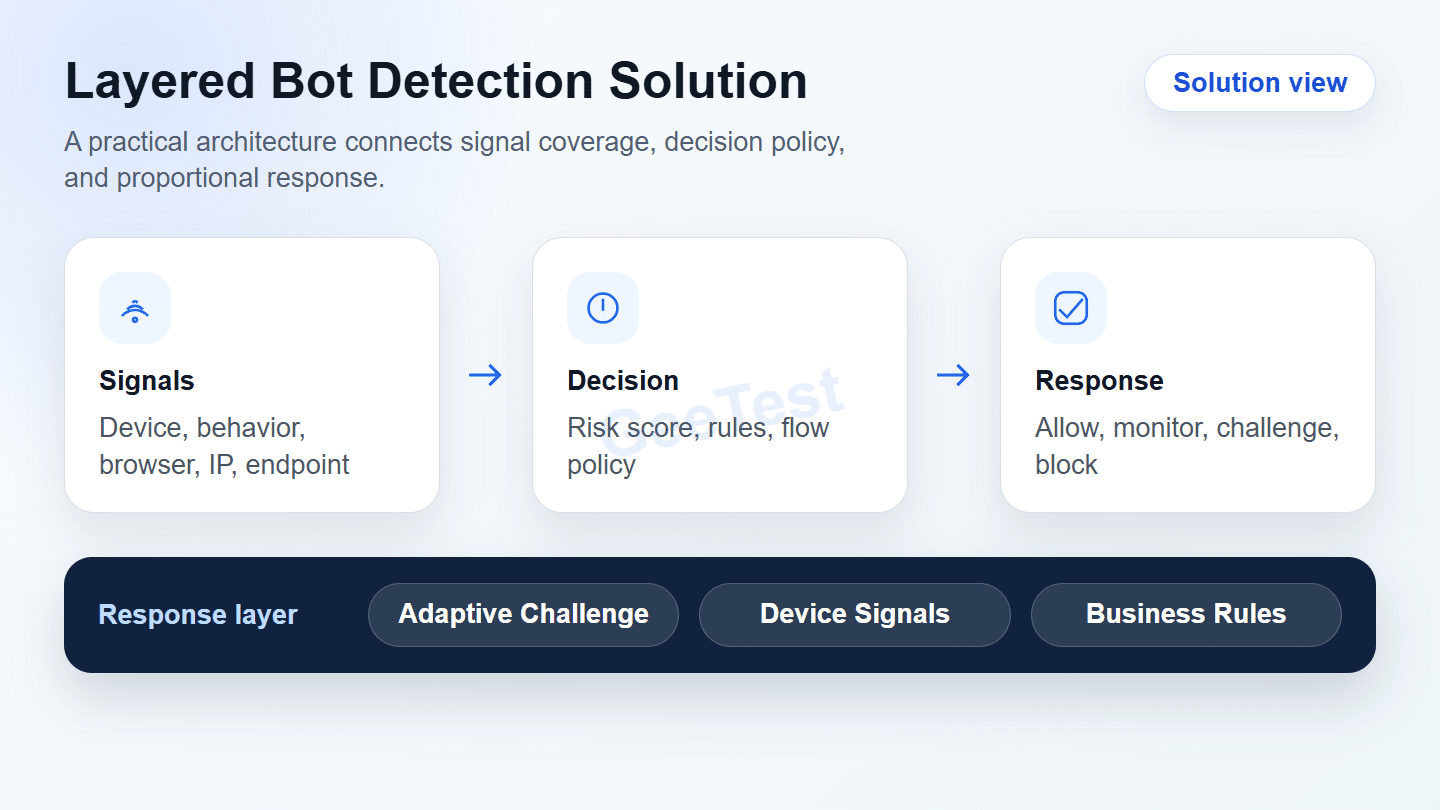
An effective bot detection solution needs three layers: signal collection, risk decisioning, and response orchestration.
| Layer | What it does | Examples |
|---|---|---|
| Signal layer | Collects evidence about traffic, device, browser, behavior, account, endpoint, and network context | IP reputation, device risk, browser automation signals, interaction behavior, request frequency |
| Decision layer | Turns signals into a risk level or policy outcome | Risk score, rules, thresholds, allowlists, endpoint policies, account history |
| Response layer | Applies the right action without overblocking real users | Allow, monitor, adaptive challenge, throttle, step-up verification, block, review |
This structure matters because one signal rarely tells the whole story. IP reputation weakens when attackers rotate residential proxies. Mobile interaction data can be noisy. A single CAPTCHA challenge can be outsourced. A WAF can catch known attack patterns while missing abuse that follows a valid business path.
The solution gets stronger when signals reinforce each other. A login request from a new device, a proxy-like network, abnormal interaction behavior, and repeated credential failures should not be treated like a normal returning customer using a familiar device.
The same architecture also helps teams avoid two common failure modes. The first is overblocking: a policy sees one suspicious signal and blocks a real customer who is traveling, using a new device, or connecting from a corporate network. The second is underreacting: a policy sees each request as low risk because the attacker is rotating IPs, slowing down attempts, or splitting the attack across many accounts. A signal-to-action model gives the system more context before it interrupts the user or lets the request continue.
For mature teams, the decision layer should support policy experiments. A new rule can run in observe mode first, giving the fraud or security team a preview of how many users it would challenge or block before enforcement begins. That preview matters most in login, checkout, and registration flows, where a false positive can quickly become a support ticket or an abandoned session.
Why Traditional Controls Are Not Enough Alone
Most enterprises already have pieces of bot defense in place. The gap is that each control sees a narrow part of the problem when it operates alone.
Web Application Firewalls (WAFs) are valuable for application-layer security, known attack patterns, and policy enforcement. They are less complete against abuse that uses valid business functions. A scraper, fake-account script, or credential-stuffing tool may not look like a classic injection attack.
MFA and 2FA strengthen account security, but they usually act after a journey reaches authentication. They can protect accounts while still leaving registration abuse, scraping, promo abuse, or API pressure unresolved. For a deeper comparison, see CAPTCHA vs. MFA vs. 2FA.
Traditional CAPTCHA can separate some humans from bots, but static challenge logic is vulnerable to solving services, automation, and accessibility friction. CAPTCHA still has a role, but modern teams should apply it adaptively. Learn more about the threat in GeeTest’s guide to CAPTCHA solving farms.
Rate limiting reduces brute-force and guessing pressure, and NIST SP 800-63B discusses throttling and adaptive controls in authentication. But rate limits still need context. A strict global limit can block legitimate bursts, while a loose limit may let distributed bots continue.
The practical answer is layered enforcement. A WAF protects the application surface. Rate limits slow repeated attempts. Device intelligence connects abuse across sessions. Adaptive verification challenges suspicious users at the right moment. Business rules translate risk into endpoint-specific policy. The goal is not to add more friction everywhere; it is to make the attack path less predictable while keeping ordinary users moving.
Choosing a Flexible Bot Detection Response Layer
After traditional controls are in place, the next decision is how the business should respond when risk is uncertain. A response layer should not be a single CAPTCHA prompt or a single block rule. It should be a policy system that can keep normal users moving, increase confidence when the signal is unclear, and apply stronger action only when the business risk justifies it.
1. Define the response ladder before tools
Start by naming the actions available to the business. The response ladder should be easy enough for security, fraud, product, and engineering teams to discuss together.
| Risk state | Typical signal pattern | Practical response |
|---|---|---|
| Trusted or low risk | Familiar device, normal behavior, known partner, healthy account history | Allow and monitor silently |
| Uncertain | New device, unusual browser environment, mild velocity, sensitive endpoint | Add device checks, observe, or trigger adaptive verification |
| High risk | Repeated failures, proxy-like traffic, emulator or automation signs, abnormal account behavior | Challenge, throttle, step up verification, or route to review |
| Confirmed abuse | Credential stuffing, scraping bursts, fake-account factory, scalping, known malicious infrastructure | Block, rate limit aggressively, suspend workflow access, or escalate |
This ladder prevents two common mistakes. One team may overreact to every suspicious signal and damage conversion. Another may underreact because each individual signal looks weak. A defined ladder lets the organization match action to risk instead of arguing about every endpoint from scratch.
2. Combine controls by flow, not by vendor category
A complete bot detection solution usually combines controls that play different roles. WAFs protect the application surface. Rate limits slow repeated attempts. Device intelligence connects suspicious activity across sessions. Behavior and browser signals add interaction context. Adaptive challenges verify users when risk crosses a threshold. Business rules decide how the action should change by endpoint.
For teams comparing vendors after mapping the architecture, the next step is a shortlist exercise: leading bot detection tools can be evaluated against the response ladder, not just against a feature checklist.
| Business flow | Signals to prioritize | Response pattern | Owner to involve |
|---|---|---|---|
| Login and account recovery | Account history, failed attempts, device risk, IP and browser signals | Rate limit, adaptive verification, account alert, review | Security, fraud, support |
| Registration and signup | Device reuse, emulator risk, behavior, phone/email quality, campaign source | Silent device risk, challenge, queue, block repeat abuse | Fraud, growth, product |
| Promotions and limited supply | Frequency, account/device links, inventory behavior, order context | Throttle, rule-based eligibility, stronger verification | Fraud, commerce, operations |
| Content, search, and APIs | Request pattern, token validity, client behavior, endpoint sensitivity | Rate limit, API policy, allow trusted automation, block scraping | Engineering, security, data |
The useful pattern is not "buy one tool and replace everything." It is to assign each control a role, then decide where the response should happen: in the browser, mobile app, edge layer, server, fraud platform, or business-rule engine.
3. Keep policy tunable after launch
Rollout should begin where abuse is already visible, usually login, registration, promotion, checkout-adjacent actions, comments, voting, content access, search, or APIs. Each flow needs its own threshold because the cost of a false positive is different. Blocking a scraper from a public catalog is not the same as blocking a returning customer from account recovery.
For credential attacks, OWASP’s Credential Stuffing Prevention Cheat Sheet is a useful reference because it emphasizes layered controls, monitoring, and response rather than a single magic control.
After launch, blocked-request volume is only one signal. Track challenge rate, challenge pass rate, login success rate, registration completion rate, checkout conversion, API error rate, account takeover reports, fraud-review volume, and customer-support complaints. If the block rate rises while conversion falls, the policy may be too aggressive. If user friction stays low but ATO or scraping continues, the policy may be too permissive.
4. Where GeeTest fits as a lightweight layer
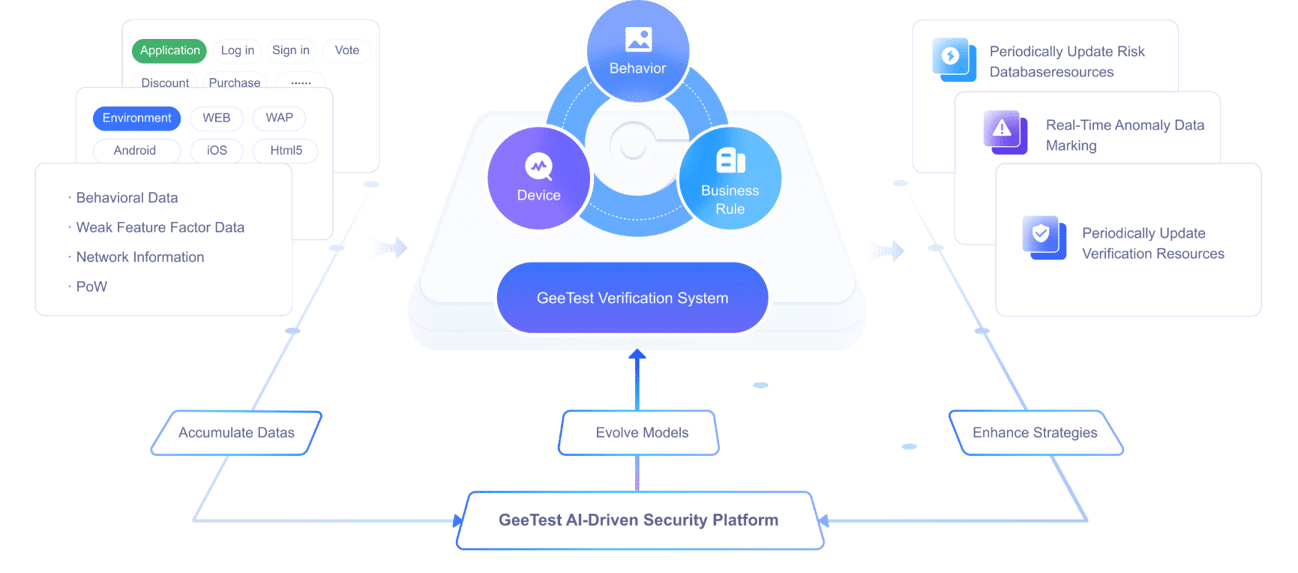
GeeTest can fit this response layer when a team needs flexible bot detection without turning every flow into a heavy platform migration. The portfolio can be combined by need:
- Adaptive CAPTCHA verifies suspicious actions with behavior, environment, and interaction signals when risk justifies a challenge.
- Device Fingerprinting adds zero-friction device and environment risk signals for fake accounts, emulators, VPNs, bots, cloud phones, and device-masking patterns.
- Business Rules Engine connects signals, lists, counters, custom functions, alerts, and endpoint context to business-specific decisions such as allow, monitor, challenge, block, or review.
In practice, a login flow may use device risk plus adaptive verification. A promotion flow may need frequency counters and business rules. A high-value action may need stricter verification, while trusted returning users should see as little friction as possible.
Final Takeaway: Build a Layered Bot Detection Solution
An effective bot detection solution is not a single switch. It is a living control system: signals change, attackers adapt, product flows evolve, and the policy has to keep up.
The most important decision is ownership. Bot detection touches security, fraud, product, growth, engineering, compliance, and support. If no team owns tuning, the policy becomes stale. If only one team owns it, the policy may optimize for one metric while hurting another. Treat bot detection as an operating system for abuse control: it needs clear owners, measurable outcomes, review cycles, and a way to adjust quickly when attackers change behavior.
If the main problem is broad application security, WAF and API controls matter. If the pressure is account takeover, device intelligence, rate limiting, and adaptive verification matter more. If the business is losing good users during abuse spikes, challenge strategy matters as much as detection accuracy.
GeeTest can support this layered response model with Adaptive CAPTCHA for suspicious interaction verification, Device Fingerprinting for zero-friction device-risk signals, and Business Rules Engine for business-specific policies. Try the GeeTest Adaptive CAPTCHA demo or contact GeeTest to evaluate the right bot detection strategy for your website, app, or API workflow.
FAQ
1. What is a bot detection solution?
A bot detection solution identifies automated traffic, evaluates risk, and applies a proportionate response. In practice, that usually means combining behavior analysis, device intelligence, IP and network signals, rules, rate limits, adaptive challenges, and monitoring.
2. How is bot detection different from bot mitigation?
Bot detection decides whether automation looks suspicious. Bot mitigation decides what to do about it, such as challenge, throttle, block, or review. A complete solution needs both.
3. Is CAPTCHA a bot detection solution?
CAPTCHA is one control inside a bot detection solution, not the whole solution. It works best as an adaptive verification step after behavior, device, account, or business-rule signals suggest that a session needs extra proof.
4. What signals should a modern bot detection solution use?
Modern bot detection should consider behavior, device, browser, IP, network, account, session, endpoint, and API signals. A single signal can be useful, but it should not carry the whole decision.
5. Where should enterprises deploy bot detection first?
Start where automation creates the clearest business damage: login, registration, checkout, campaign claims, voting, comments, content access, and APIs. Those flows usually give teams the fastest evidence for tuning policy.