
To prevent DDoS attacks, organizations need several defenses working at different layers. Upstream filtering and traffic-scrubbing capacity help absorb large floods. CDN and load-balancing infrastructure distribute traffic. Firewalls, connection controls, rate limits, caching, and application defenses protect individual resources. Monitoring and a tested response plan help the team act before an overloaded service becomes a prolonged outage.
No single product can make a public service immune to DDoS attacks. The practical goal is to reduce exposed attack surfaces, prevent attackers from bypassing edge controls, protect the origin from unnecessary work, and give responders clear options when traffic changes suddenly.
What Is a DDoS Attack?
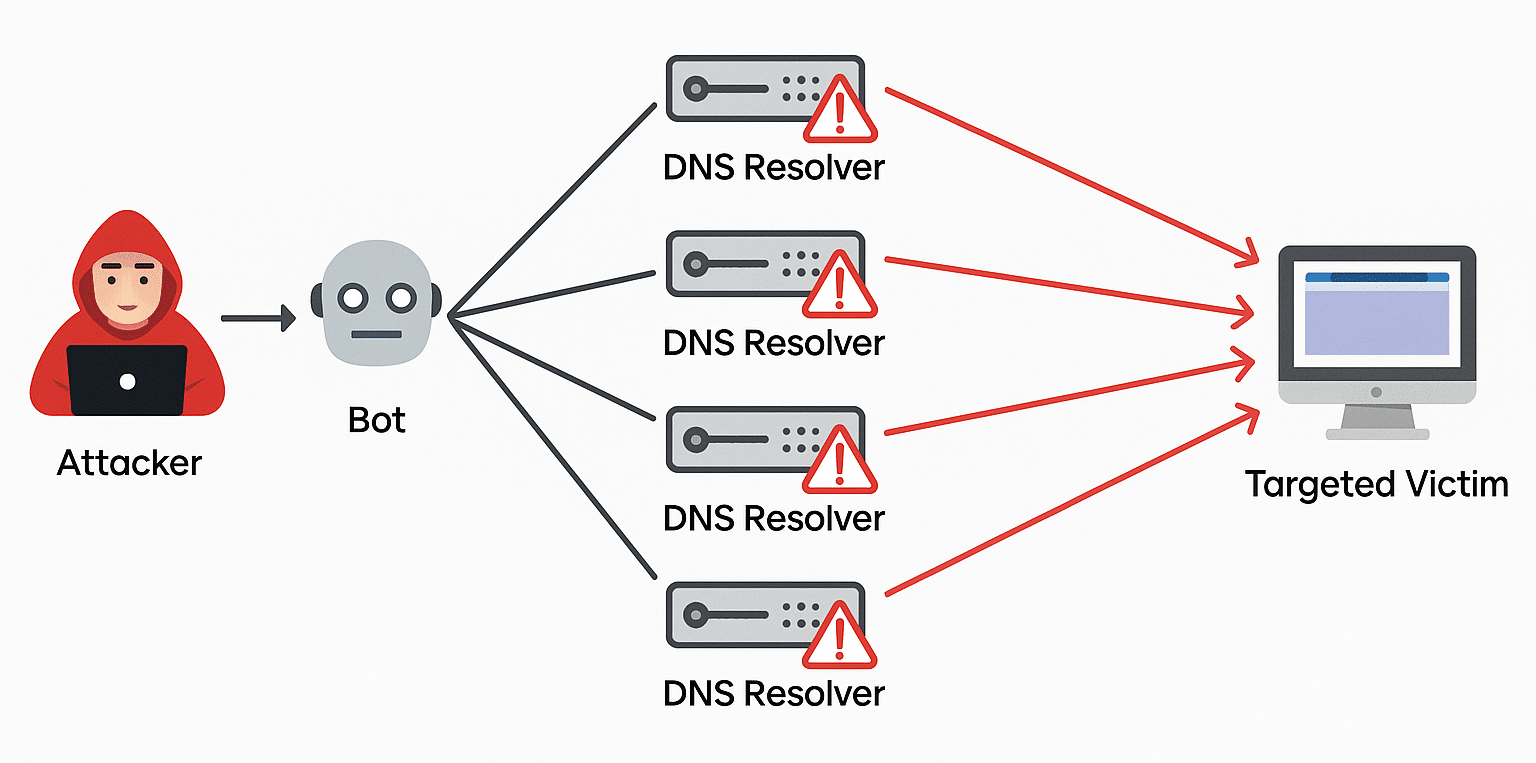
A distributed denial-of-service (DDoS) attack attempts to make a website, API, server, or network unavailable by sending more traffic or requests than the target can handle. The traffic comes from many sources, often compromised devices organized into a botnet. Distribution makes the attack harder to stop with a single IP block and allows attackers to pressure several parts of a service at once.
The exhausted resource depends on the attack. A volumetric flood can fill an internet link. A protocol attack can consume firewall or connection-table capacity. An application-layer attack can repeatedly trigger expensive login, search, checkout, or API operations. Effective DDoS prevention begins by identifying which resource each control protects.
How Does a DDoS Attack Work?
Attackers first assemble or rent distributed traffic sources. These may include infected computers and IoT devices, cloud servers, open proxies, or systems that can be abused for traffic amplification. The sources then send coordinated packets, connections, or HTTP requests toward the same service.
The target does not always fail because its web server reaches 100% CPU. The upstream link may saturate before traffic reaches the server. A firewall or load balancer may run out of connection state. An API may remain reachable but slow down because every request triggers database queries or third-party calls. Retries from legitimate users can then add more load to an already stressed system.
This is why a response based only on blocking visible IP addresses is fragile. Attack sources can rotate, spoof addresses, move across networks, or resemble normal users. Defenders need edge capacity, origin restrictions, protocol hardening, application policies, and response coordination.
DoS vs. DDoS: What Is the Difference?
A DoS (Denial of Service) attack usually originates from one system or a limited source. A DDoS attack distributes traffic across many systems. That difference changes the scale and the response: a single-source attack may be contained with a targeted network rule, while a distributed attack often requires upstream providers, large filtering capacity, and behavioral decisions based on more than IP address alone.
Both can make a service unavailable, and both can target the network or the application. The word “distributed” describes the sources, not the exact technique. Response teams still need to determine whether bandwidth, connection state, server resources, or an expensive business workflow is failing.
| Comparison point | DoS attack | DDoS attack |
|---|---|---|
| Traffic sources | One system or a limited source set | Many distributed systems or networks |
| Typical containment | Targeted filtering may be sufficient when the source is stable | Upstream filtering, scrubbing capacity, and behavioral controls are often required |
| Attribution signal | A smaller source set may be easier to isolate | Rotating, spoofed, or widely distributed sources reduce the value of single-IP blocking |
| Response priority | Protect the resource stressed by the source | Coordinate network, edge, origin, application, and provider response |
The Three Main Types of DDoS Attacks
1. Volumetric attacks
Volumetric attacks attempt to consume available bandwidth with a very large quantity of traffic. Reflection and amplification techniques can make the traffic reaching the victim much larger than the traffic sent by the attacker. These attacks are best handled before they reach a constrained link, using upstream filtering, anycast networks, CDNs, or dedicated scrubbing services.
2. Protocol and state-exhaustion attacks
Protocol attacks exploit how network devices and servers handle connections. SYN floods are a familiar example: the attacker starts large numbers of connections without completing them, filling state tables and preventing legitimate connections. Firewalls, load balancers, operating-system settings, provider protections, and carefully tested timeouts or connection limits are central controls.
3. Application-layer attacks
Application-layer attacks send requests that appear closer to normal web or API activity. Instead of maximizing raw bandwidth, they repeatedly call functions that are expensive to process, such as login, password recovery, search, report generation, checkout, or API queries. Teams should combine WAF policies, endpoint-specific API rate limiting, caching, identity and account context, and selective bot controls.
The impact of DDoS attacks is visible in several well-known incidents. An AWS Shield threat report documented mitigation of a 2.3 Tbps event in 2020. The 2016 Dyn attack disrupted access to major online services through DNS infrastructure. GitHub’s 2018 DDoS incident report describes a large amplification attack and upstream mitigation. Cloudflare’s Q1 2025 DDoS report illustrates how attack scale and methods continue to evolve. Together, these examples show why organizations need defenses matched to the network, protocol, and application layers.
How to Detect a DDoS Attack Early
A traffic spike alone does not prove an attack. Product launches, media coverage, software defects, dependency failures, and client retry loops can create similar symptoms. Detection should compare current behavior with a healthy baseline across the edge, origin, application, and database.

Warning signs include:
- sudden growth in bandwidth, packets, connections, or half-open connections;
- latency and error rates rising in one region or on one endpoint;
- repeated requests for dynamic or uncached resources;
- origin CPU, memory, queue depth, database waits, or connection pools reaching limits;
- a sharp fall in cache-hit ratio;
- unusual IP, ASN, geography, device, account, or user-agent distributions;
- many sessions that repeat one action without completing a normal customer journey;
- legitimate clients retrying after timeouts and amplifying the load.
Correlate provider telemetry, WAF events, application traces, endpoint cost, account state, and sampled sessions. The first operational question is not simply “Is this DDoS?” It is “Which resource is failing, and which traffic can we reduce without locking out legitimate users?”
How to Prevent DDoS Attacks: 8 Essential Strategies for 2026
The most effective way to prevent DDoS attacks in 2026 is to protect each potential bottleneck with the control best suited to it. The following eight strategies cover exposure, upstream capacity, traffic distribution, protocol hardening, application policy, origin efficiency, bot control, and incident readiness.
| Strategy | Primary layer | Resource protected | Core action |
|---|---|---|---|
| Map exposed services and hide the origin | Architecture and exposure | Public services and origin addresses | Remove unnecessary exposure and prevent direct-to-origin bypass. |
| Put scalable edge and scrubbing capacity in front of traffic | Network edge | Bandwidth and upstream connectivity | Absorb and filter large floods before they reach constrained infrastructure. |
| Use intelligent routing and load balancing | Traffic distribution | Healthy nodes, regions, and shared capacity | Route legitimate demand across available resources and fail away from unhealthy ones. |
| Harden protocols, ports, and connection handling | Network and transport | Firewalls, load balancers, and connection tables | Close unused paths and tune protocol and connection controls under tested load. |
| Apply WAF policies and endpoint-specific rate limits | Application edge | Web routes, APIs, and expensive operations | Enforce controls based on route cost, identity, operation, and risk. |
| Reduce the work required from the origin | Application and origin | Compute, databases, queues, and dependencies | Cache, queue, limit, and gracefully degrade work before resources are exhausted. |
| Add selective application-layer bot controls | Application workflow | Login, registration, search, checkout, and sensitive APIs | Evaluate automation risk before costly actions and challenge only where appropriate. |
| Rehearse detection, escalation, and recovery | Operations and response | Service availability and recovery capacity | Predefine ownership, emergency controls, communications, and gradual restoration. |
1. Map exposed services and hide the origin
Inventory public domains, APIs, ports, DNS dependencies, management interfaces, test systems, and third-party endpoints. Remove services that do not need internet access. If a CDN or reverse proxy protects the site, restrict direct access to the origin so attackers cannot bypass the edge through an old DNS record, forgotten subdomain, IPv6 address, or leaked server address.
2. Put scalable edge and scrubbing capacity in front of traffic
CDNs, anycast networks, and specialist DDoS mitigation providers can distribute traffic and filter attacks before they reach a narrow connection or origin. Confirm which protections are automatic, which require manual activation, which attack layers are covered, and how the provider will be contacted during an incident. A service subscription without a tested escalation path is not a complete defense.
3. Use intelligent routing and load balancing
Spread legitimate demand across multiple healthy resources and regions where the architecture supports it. Health checks should stop sending traffic to failed nodes, while failover and routing rules should protect essential services. Load balancing increases resilience, but it does not create unlimited capacity; the upstream network and every shared dependency must also be considered.
4. Harden protocols, ports, and connection handling
Close unused ports, patch internet-facing systems, apply anti-spoofing controls where appropriate, and test firewalls, load balancers, and operating-system connection settings under pressure. Tune connection limits and timeouts carefully. Limits that are too loose waste resources, while limits that are too strict can turn a legitimate traffic burst into self-inflicted denial of service.
5. Apply WAF policies and endpoint-specific rate limits
Global request limits are usually too blunt. A homepage, login endpoint, search query, GraphQL operation, token request, and checkout action have different costs. Apply limits by route, identity, operation, and risk when possible. Decide what happens when a threshold is reached: block, slow down, queue, return cached data, reduce functionality, or require verification. Guidance on bot traffic and bot mitigation can help separate automated abuse from normal demand.
6. Reduce the work required from the origin
Cache safe responses, queue work that does not need to complete synchronously, use circuit breakers for unstable dependencies, and set budgets for database or downstream calls. Autoscaling can help with legitimate surges and some attacks, but it should be paired with spending safeguards and admission controls. Design graceful degradation so a secondary feature cannot exhaust the entire service.
7. Add selective application-layer bot controls
When automated traffic targets login, registration, password recovery, search, promotions, checkout, or APIs, make a risk decision before the expensive action runs. Combine request behavior with account, device, and workflow context. Effective bot detection and device fingerprinting can support allow, limit, challenge, or review decisions without treating every user the same.
8. Rehearse detection, escalation, and recovery
Document who can contact providers, activate emergency controls, modify WAF or rate-limit rules, disable nonessential features, communicate with customers, and approve recovery. Exercise the plan before an incident. During recovery, restore traffic gradually so simultaneous client retries do not trigger a second outage. Review false positives, user impact, recovery time, and the resource that actually failed.
How Application-Layer Verification Complements DDoS Controls
GeeTest is relevant when automated traffic targets an application workflow and the service still has enough capacity to evaluate a request. It is not a replacement for CDN capacity, network filtering, a WAF, DDoS scrubbing, load balancing, resilient infrastructure, or incident response.

Block malicious automation before costly actions
For application-layer floods, the useful enforcement point is before the request triggers significant application, database, or third-party work. GeeTest can help teams distinguish lower-risk users from suspicious automation and apply a verification step at selected endpoints.
Use adaptive, risk-based verification
A blanket challenge on every request can create accessibility and conversion problems. GeeTest Adaptive CAPTCHA can be evaluated as a selective response: lower-risk sessions continue with minimal friction, while higher-risk sessions receive an appropriate challenge. Thresholds should account for traffic velocity, account state, device context, endpoint cost, and earlier outcomes.
Protect APIs and sensitive business flows
Authentication, data queries, transactions, promotion claims, and account recovery are frequent targets because each request can trigger meaningful work. Teams can combine server-side authorization, route-specific rate limits, caching, account controls, and human verification where a real user is expected. CAPTCHA should not be placed on machine-to-machine API traffic that cannot complete a human challenge.
Complement the infrastructure stack
Application controls are most useful as one layer in a broader design. Edge and network services handle volume before it reaches the application. The application then uses identity, behavior, device, and business context to protect specific workflows. Security, SRE, product, privacy, and support teams should agree on thresholds, fallback paths, monitoring, and ownership.
Build DDoS Resilience Before the Next Attack
Preventing DDoS attacks in 2026 does not mean relying on one appliance or expecting every malicious request to be identified in advance. It means building layered resilience: reduce unnecessary exposure, absorb large floods upstream, distribute legitimate traffic, harden connection handling, control costly endpoints, reduce origin work, apply selective bot defenses, and rehearse recovery.
GeeTest fits into that design at the application layer, where automated requests target workflows such as login, registration, account recovery, search, checkout, or API operations. It complements—not replaces—CDNs, WAFs, scrubbing services, resilient infrastructure, and an incident-response process.
The practical next step is for security, SRE, and application owners to map each public service to the resource it could exhaust, assign one preventive control and one incident owner to every high-risk path, and test the resulting playbook before the next traffic surge.
Frequently Asked Questions
1. What is the best way to prevent a DDoS attack?
Use layered protection. Reduce exposed services, hide the origin, place scalable edge and scrubbing capacity in front of traffic, harden protocols, apply WAF and endpoint-specific limits, make the origin resilient, monitor healthy baselines, and rehearse incident response. The exact mix depends on which resource the attack is trying to exhaust.
2. Can a firewall prevent DDoS attacks?
A firewall can block unwanted ports, enforce connection policies, and mitigate some protocol or application patterns. It cannot absorb a flood larger than the available upstream connection, and the firewall itself may become a bottleneck. Large attacks usually require provider-side filtering or scrubbing before traffic reaches the local network.
3. Does a VPN prevent DDoS attacks?
A VPN may hide an individual user’s public IP in some situations, but it does not provide complete DDoS protection for a public website or API. Public services still need upstream capacity, edge filtering, origin protection, application controls, monitoring, and incident response.
4. What should a team do during an active DDoS attack?
Confirm which layer and resource are failing, contact the upstream or mitigation provider, activate pre-approved controls, protect essential routes, reduce expensive nonessential functions, record changes, and communicate through the incident plan. Restore normal traffic gradually after the service stabilizes.