
An anti-bot solution is not simply a tool that labels traffic as human or automated. It is a risk-to-action system: it helps a business decide which activity to allow, which activity to verify, and which activity to stop. The hard part is balancing abuse prevention with legitimate-user experience, accessibility, partner traffic, and the operating cost of false positives. A useful evaluation therefore starts with the business action at risk, not with a vendor’s feature list.
The roadmap summarizes five connected evaluation stages: business risk, signals, response, operations, and proof.

Start With the Business Risk You Need to Control
1. Identify the flow, loss, and acceptable friction
Begin with the action an attacker can influence, not with a vendor’s feature list. Credential stuffing threatens account access; scraping can expose pricing or inventory; fake registrations consume promotions; automated checkout can hoard scarce goods; and API abuse can distort a product or marketplace.
For each priority flow, write down four things:
- the action being abused;
- the likely financial, operational, or customer impact;
- the amount of friction the business can accept; and
- the team that owns the response.
This makes the evaluation concrete. A login flow, a public content page, and a payout-change flow should not inherit the same threshold simply because they use the same website.
The MITRE ATT&CK credential-stuffing technique is a useful reminder that the control objective is specific: protect an authentication flow from the unauthorized reuse of obtained credential pairs. The anti-bot solution is valuable only when it protects the business action that matters.
2. Separate useful automation from harmful automation
Not all automated traffic is unwanted. Search crawlers, uptime monitors, and authorized partner integrations may be important to the business. Assistive-technology use is legitimate user activity; different interaction patterns are not, by themselves, evidence of automation or abuse.
A useful classification considers identity, authorization, behavior, and business effect. Preserve known-good activity, observe uncertain activity, and reserve hard enforcement for traffic whose risk and impact justify it. This is why bot detection should feed a policy decision rather than act as a one-bit gate.
Build Confidence From More Than One Signal
An anti-bot solution should make a decision from context, not from one easily changed attribute. IP reputation and request-rate rules still catch obvious abuse, but distributed infrastructure, mobile emulators, residential proxies, and human-assisted activity can make isolated requests look normal.
1. Combine network, device, behavior, and account context
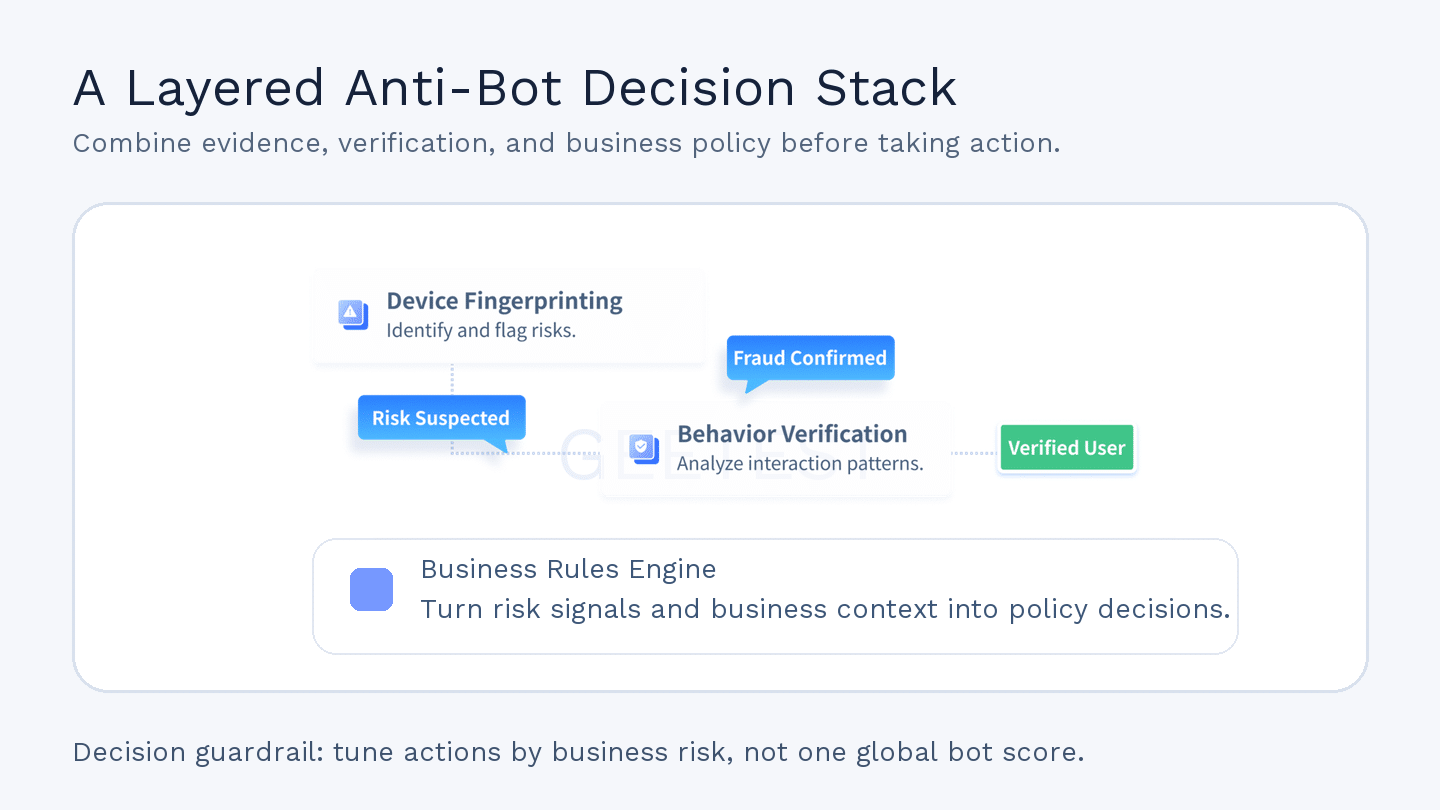
Modern anti-bot detection can combine network conditions, browser and device characteristics, navigation and timing patterns, account history, and action frequency. The point is not to collect every possible signal. It is to gather enough independent evidence at the moments where a wrong decision has material cost.
This is the useful lesson from the technology’s evolution: newer layers do not automatically replace older ones. Static rules, application controls, device intelligence, behavior analysis, and verification answer different questions. The solution should show how those signals work together and what happens when one is missing.
2. Ask how analysts can explain a decision
A risk score is a confidence indicator, not a verdict. Two requests with the same score may deserve different actions when one reads a public page and the other changes a payout destination. During evaluation, ask vendors to show:
- which signal families influenced a decision;
- how conflicting or missing evidence is handled;
- how an analyst reviews challenged and blocked traffic; and
- how a decision maps to a business rule and a recovery path.
Opaque scores make false-positive investigation and policy tuning harder. Explainability is therefore an operating requirement, not a reporting extra.
Match the Response to the Risk Tier
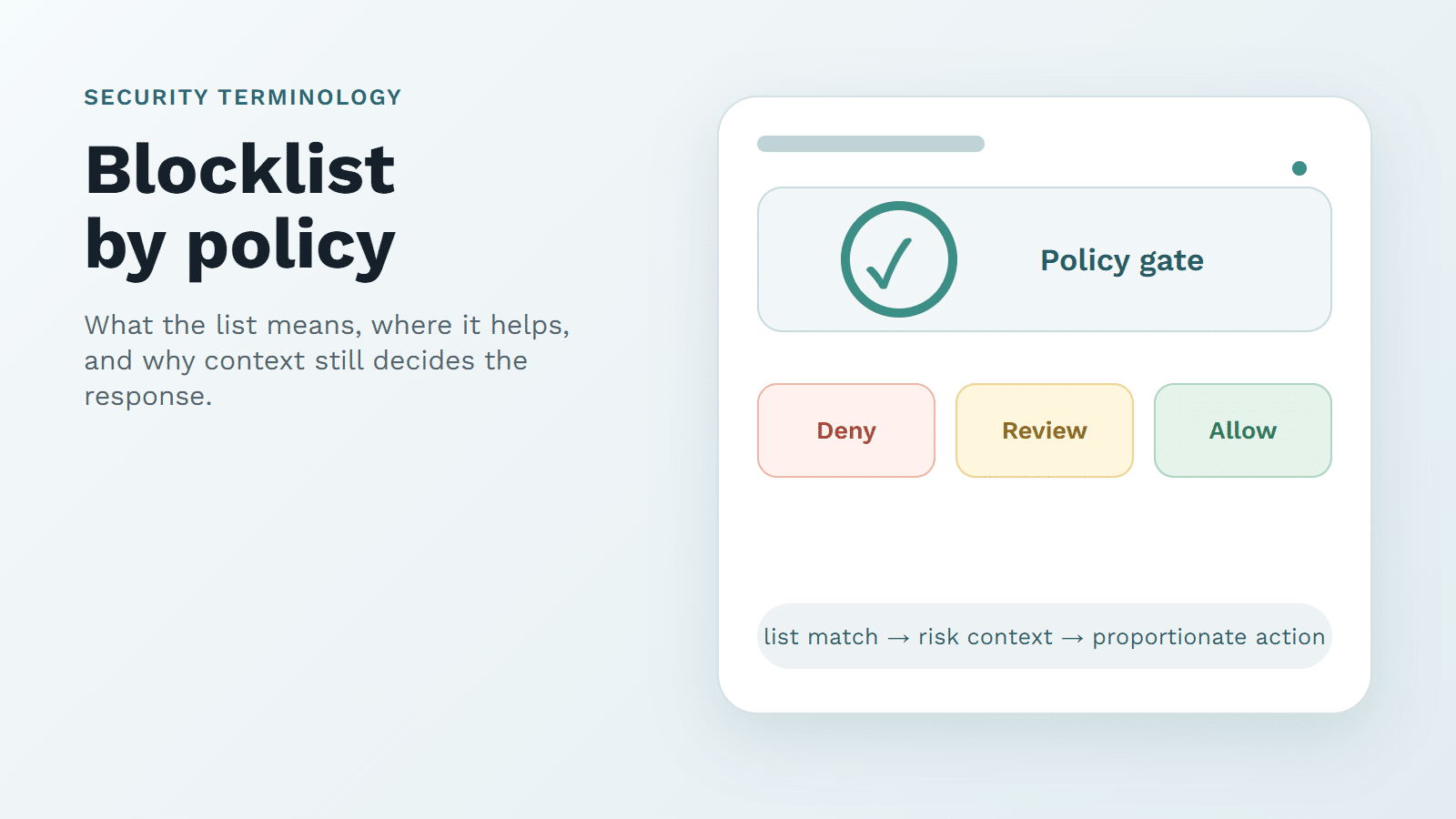
Detection becomes useful only when it leads to an action that fits both confidence and business impact.
| Risk and impact | Proportionate action | Buyer question |
|---|---|---|
| Low risk, low impact | Allow and log | Can normal users and good bots pass without added latency? |
| Uncertain signal, low impact | Monitor or reduce privileges | Can the team collect evidence without breaking the journey? |
| Uncertain signal, high impact | Step up with verification | Is the challenge recoverable and proportionate? |
| High-confidence, reversible abuse | Throttle, queue, or limit | Can the policy contain damage while preserving investigation data? |
| High-confidence, severe abuse | Block and escalate | Are reasons, alerts, and rollback controls available? |
1. Use the least disruptive action that still protects the flow
One global block rule often converts uncertainty into lost conversions, support tickets, or partner disruption. A graduated response lets the business protect a high-value action without challenging every visitor. It also gives analysts room to learn from uncertain traffic before enforcing a permanent decision.
2. Design recovery before enforcement
False positives are managed through accessible challenges, alternate verification, retry limits, support recovery, analyst review, and rapid rollback. The W3C Web Content Accessibility Guidelines 2.2 provide a neutral benchmark for accessible interaction and authentication; they are not a substitute for testing the actual protected journey.
Define fallback behavior per flow. Failing open may be acceptable for public reading, while changing account credentials or payout details may require stricter protection. Ask what happens when a script fails to load, a mobile connection is unstable, or the decision service is unavailable.
Test Production Fit and Operating Ownership
1. Test every surface where abuse creates cost
Coverage claims must be tested where the business operates: web routes, native apps, APIs, login, registration, password reset, search, checkout, messaging, and promotions. A browser-only control may miss direct API automation. An edge-only control may lack account or transaction context.
Use a small test inventory and record latency, data flow, privacy review, regional constraints, failover behavior, and integration effort. When comparing bot protection software, separate detection coverage from deployment and maintenance fit.
2. Assign tuning, reporting, and rollback owners
Security may own threat policy, fraud teams may own transaction outcomes, product teams may own friction budgets, engineering may own reliability, and support may see false positives first. If those responsibilities are not explicit, the system can be technically deployed but operationally unmanaged.
Require dashboards and raw decision data, not only a detection demo. Teams should be able to review trends by flow and action, distinguish policy changes from model changes, export evidence for incidents, and follow a documented tuning and rollback process.
For a layered implementation, GeeTest can be evaluated by role rather than as a single "do everything" product: Adaptive CAPTCHA can provide step-up verification, Device Fingerprinting can add device-risk evidence, and Business Rules Engine can connect those signals to customer-specific policy. The buyer should verify the exact data flow and operating boundaries during technical evaluation.
Prove the Solution Before Full Rollout
1. Measure security and legitimate-user outcomes together
A proof of value should compare a baseline with controlled enforcement. "Bots blocked" is not enough because an overly aggressive rule can improve that number while damaging the customer journey.
Track a short set of paired measures:
- confirmed abuse stopped or contained;
- analyst-confirmed false positives and false negatives;
- challenge rate, pass rate, retries, and abandonment;
- added latency and service errors;
- investigation time, alert quality, and tuning frequency; and
- fallback and rollback behavior under failure.
Segment results by route, device, geography, account state, and action. Averages can hide a serious problem in one region or one high-value flow.
2. Move from shadow mode to controlled enforcement
Start in shadow mode so the team can inspect how proposed policies classify good bots, partner traffic, uncertain sessions, and high-risk cohorts. Then enforce on one flow or traffic segment, review the agreed thresholds, and expand only when security and customer metrics remain inside the business’s tolerance.
The final procurement decision should cover deployment support, policy transparency, reporting depth, incident escalation, privacy requirements, commercial terms, and the people responsible for continued tuning. A short controlled test is more informative than a broad promise of "complete protection."
The Right Anti-Bot Solution Is the One You Can Operate
The core decision is simple: choose the anti-bot solution that connects the flow at risk to credible signals, proportionate actions, accountable ownership, and measurable proof. That usually means combining detection, device or behavior evidence, verification, and business policy instead of asking one control to stop every form of automation. Security, product, and engineering teams can discuss a proof-of-value plan with GeeTest to map high-risk flows, candidate signals, response tiers, and success metrics before broad enforcement.
FAQ
1. What is an anti-bot solution?
An anti-bot solution identifies automated or suspicious activity, estimates its risk, and applies a policy response such as allowing, monitoring, verifying, limiting, or blocking. Enterprise systems usually combine network, browser, device, behavior, account, and business-action context.
2. How can bots be prevented?
Protect the business flows that matter, combine multiple signals, apply rate and access controls, use risk-based verification when confidence is incomplete, block high-confidence abuse, and continuously review outcomes. Preserve authorized automation through explicit identity and policy rules.
3. Is CAPTCHA enough to stop bots?
No. CAPTCHA can collect human-interaction evidence and raise the cost of basic automation, but it does not evaluate every device, account, session, or downstream action. Use it as one step-up response within a broader anti-bot policy.
4. What makes an anti-bot solution enterprise-ready?
It should cover the required web, mobile, and API flows; explain how signals become decisions; support proportionate responses; manage false positives and accessibility; provide reporting and rollback; fit existing operations; and prove value against both security and legitimate-user metrics.